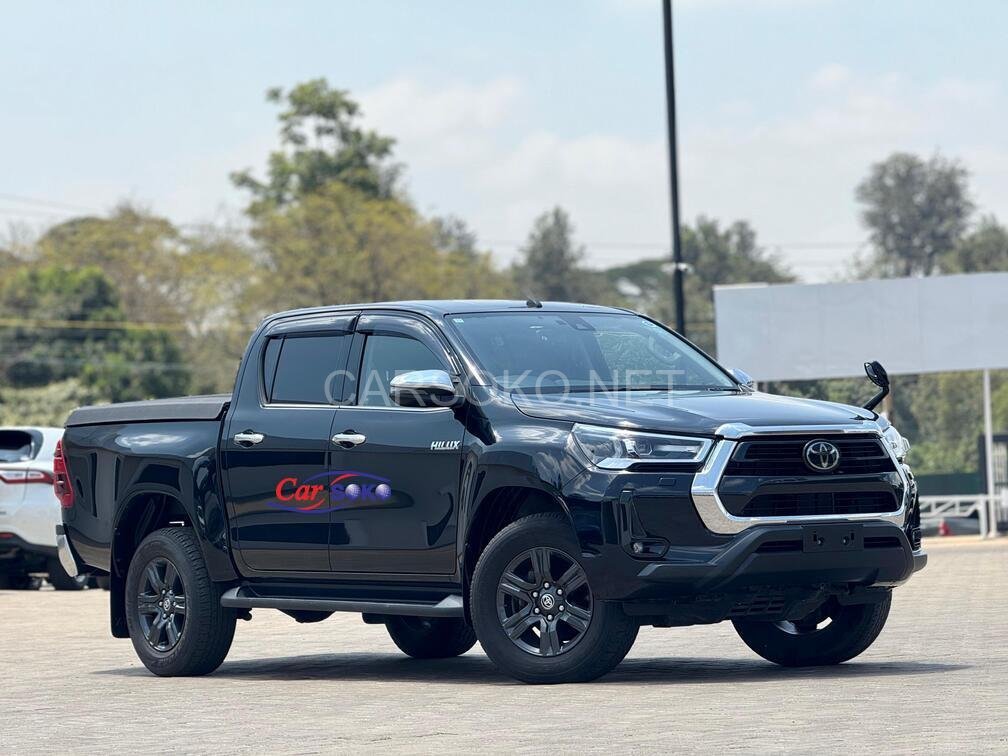
This comparison comes up constantly. Walk into any car dealer conversation in Nairobi, bring it up in a group of professionals who spend time on Kenya's roads, and you'll get strong opinions on both sides. The Hilux camp tends to be immovable. The Ranger camp has grown significantly over the past four years and isn't going anywhere. They're both good. They're good in different ways. And the right answer depends almost entirely on what your driving life actually looks like.
Basics of What You're Actually Comparing
Both are double-cab pick-up trucks that have evolved into genuine lifestyle vehicles for Kenyan buyers. Neither is purely a work vehicle anymore. Both offer premium cabin appointments, capable four-wheel drive systems, and the practical flexibility of a truck bed alongside a proper rear seat.
The Toyota Hilux in its current eighth-generation form (2015 onwards, facelifted in 2020) runs a 2.8-litre diesel producing 204 horsepower and 500 Nm of torque. The Ford Ranger in its current next-generation form (T6.2, launched in Kenya from 2023) runs a 3.0-litre V6 turbo diesel producing 240 horsepower and 600 Nm of torque, or a 2.0-litre bi-turbo diesel producing 170 horsepower depending on the variant.
On paper the Ranger has more power and torque in its top variants. That's real and you notice it. But paper specs aren't the whole story here, and they probably aren't the most important part of this comparison for most Kenyan buyers.
Reliability and Running Costs What Actually Decides This
If you ask Kenyan mechanics, fleet managers, and high-mileage drivers which of these two has the stronger reliability record in this market over the past decade, most will point to the Hilux. That's not sentiment. The Hilux has been running on Kenyan roads in large numbers for long enough that its failure patterns are well understood, and its reputation for durability on rough terrain and in demanding conditions is earned.
That doesn't mean the Ranger breaks down. It doesn't. But the Ranger's more complex drivetrain particularly the newer T6.2's advanced electronics, the 10-speed automatic gearbox on V6 variants, and the more sophisticated suspension system means that when something does go wrong, it tends to cost more to fix and takes longer to source parts for. Kenya's Ford service network has improved. It's still not as deep or as geographically distributed as Toyota's.
For buyers whose vehicles will primarily cover Nairobi and major highway routes between cities, this gap is manageable. For buyers operating regularly in areas more than three hours from a major service centre, it matters more.
Hilux 2.8-litre diesel average fuel consumption in Kenya: 9 to 12 litres per 100km mixed use. Ranger 2.0 bi-turbo: 10 to 13 litres. Ranger V6 3.0: 11 to 15 litres. Differences are real over 2,000km per month.
On-Road Experience the Ranger Pulls Ahead
Drive a next-generation Ford Ranger Wildtrak or Ranger Sport back-to-back with a current Hilux SR5 or GR Sport, and the Ranger feels like a more modern vehicle. The cabin is quieter. The infotainment is more capable the 12-inch portrait touchscreen in the new Ranger is genuinely good by any standard, not just truck standards. The suspension tuning is more comfortable on tarmac. And the V6's power delivery is noticeably stronger when you need it.
If a significant portion of your driving is highway kilometres and city commuting, and you want a truck that feels closer to a proper premium SUV inside, the Ranger makes a strong case. Several buyers we speak to who use their pick-up primarily as a daily driver in Nairobi have moved toward the Ranger for exactly this reason.
Both Are Capable Off-Road, One Has More History Here
Both vehicles have proper four-wheel drive systems with low-range transfer cases and locking rear differentials. Both handle Kenya's rough terrain competently. The Hilux's proven track record on East African roads in game parks, agricultural areas, and remote upcountry routes gives it a level of tested credibility that the newer Ranger platform hasn't fully accumulated yet in this specific market.
The Ranger Raptor, if you're considering that variant, is a genuinely different vehicle in terms of off-road capability Fox suspension, superior approach and departure angles, and a tuning philosophy that's closer to a proper off-road machine. But it's priced accordingly and isn't the right tool for everyone.
Price Comparison in Kenya's 2026 Market
|
Variant |
Toyota Hilux (KES) |
Ford Ranger (KES) |
|
Base double-cab diesel (2019–2021) |
3.2M – 4.5M |
3M – 4.2M |
|
Mid-spec (Wildtrak / SR5, 2020–2022) |
4.5M – 6M |
4.5M – 6.5M |
|
Top-spec (GR Sport / Raptor, 2022+) |
7M – 10M |
8M – 13M |
|
Brand new (2024–2026 models) |
6.5M – 9M |
7M – 11M |
The Honest Verdict
Buy the Hilux if you regularly operate outside major cities, long-term reliability and service network depth matter more than cabin refinement, you tow or carry loads frequently, or you simply want the vehicle whose track record in this market is the most proven.
Buy the Ranger if your driving is predominantly urban and highway, you want a more modern cabin and infotainment experience, the V6's stronger performance is useful to you, or you're attracted to the Ranger's more premium feel as a daily driver.
Both are good choices. Neither is wrong. The mistake is buying the wrong one for your actual life, not your hypothetical life. At Car Soko, we stock both. Our team will ask you the right questions before recommending either. Because the best pick-up is the one that fits how you actually use it.
Browse verified Toyota Hilux and Ford Ranger listings at Car Soko. Honest advice, full documentation, no pressure. Visit: www.carsoko.net